
|
The following examples show a few of the most commonly used vanilla, exotic and structured currency options strategies for hedging, trading and investment purposes. In all cases the following data has been assumed:
Currency = USD/DEM
Forward Reference = 1.5673
Expiry = 3 months
Volatility = 9.8%
Spot Reference = 1.5700
The following strategies illustrate ways of using options to hedge a transactional exposure, assumed to be a short US Dollar/long Deutschemark position, booked at 1.5700.
Buy USD Call DEM Put Strike 1.5700
Premium Cost = 1.83% USD (287 DEM pips)
| Scenarios at Expiry | ||
| Spot above 1.5700 | Underlying hedged at effective rate of 1.5987 | |
| Spot below 1.5700 | Underlying benefits below break-even 1.5413 | |
This is the most straightforward option hedge available. The option purchaser has the right to buy USD at 1.5700, if the spot trades above 1.5700 at expiry. The effective exchange rate for the hedger, should the option be exercised, is 1.5700 + 0.0287 = 1.5987. To the downside, gains on the underlying cash position begin to offset the cost of the option, breaking even at an exchange rate of 1.5413. The maximum profit of the combined structure is unlimited below this level.

Buy USD Call DEM Put Strike 1.6000
Sell USD Put DEM Call Strike 1.5365
Net Premium Cost = Zero
| Scenarios at Expiry | ||
| Spot above 1.6000 | Underlying hedged by purchase option | |
| Spot between 1.5365/1.6000 |
Underlying exchanged at prevailing spot rate | |
| Spot below 1.5365 | Profits on underlying capped by sold option | |

This strategy is also known as Risk Reversal, Collar or Cylinder. It provides the hedger with the right to buy USD at 1.6000, if spot trades above 1.6000 at expiry, or with an obligation to buy USD at 1.5365, if spot trades below that level at expiry. The strike prices in this example are set so that the premium received from the sold option equals the premium paid for the purchased option, making the transaction premium free. When combined with the short cash position, the exposure is locked into a range. In this example the maximum cost at expiry would be 300 DEM pips and the maximum profit 335 DEM pips.
Buy USD Call DEM Put Strike 1.5700
Fixing frequency = Weekly every Friday (12 fixings)
Premium Cost = 1.15% (180.5 DEM pips)
| Scenarios at Expiry | ||
| Average above 1.5700 | Underlying hedged at effective average rate of 1.58805 | |
| Average below 1.5700 | Underlying benefits below average rate 1.55195 | |
The Average Rate Option provides the holder with the right to receive the difference between the strike price and the average rate at maturity. For example, if the average rate of the twelve weeks is fixed at 1.6200, the option holder will receive the difference, i.e. 500 DEM pips as a cash settlement. The ARO is particularly suited to a hedger who wishes to cover the exposure for a series of cash flows.
N.B. The ARO is a cash-settled instrument, not a deliverable one. Thus when hedging an underlying exposure, cash flows would need to be converted in the underlying market on the relevant fixing dates. This ensures that the hedge instrument effectively offsets the aggregate FX rate of the cash flow conversions.
Buy USD Call DEM Put Strike 1.5700
Initially Zero Cost
Premium Trigger Levels: 1.5300, 1.5100, 1.4900
Premium at each Level: 1.50% $ (235.5 DEM pips)
| Scenarios at Expiry |
Mini-Premium Levels Traded |
Effective Hedge Rate for Underlying |
|||
| > 1.5700 | None | 1.5700 | |||
| 1.5300 | 1.59355 | ||||
| 1.5300 and 1.5100 | 1.6171 | ||||
| 1.5300, 1.5100 and 1.4900 | 1.64065 | ||||
| < 1.5700 | None | Spot | |||
| 1.5300 | Spot + 235.5 DEM pips | ||||
| 1.5300 and 1.5100 | Spot + 471 DEM pips | ||||
| 1.5300, 1.5100 and 1.4900 | Spot + 706.5 DEM pips | ||||
Initially, no premium is paid. However, if any of the above premium trigger levels trade at any time before expiry, the hedger would have to pay 235.5 DEM pips at each level. Therefore, if all three levels trade at any time before the option expiry, a total of 706.5 DEM pips would have to be paid to the option seller at maturity. This would be a larger premium than one would have paid for the equivalent European option (c.f. 1.83% $ or 287 DEM pips), but in order for the trigger levels to have been reached, the cash would have moved in favour of the hedger’s underlying position. If none of the three levels trades at any time before the option expiry, then the option will have been acquired for zero cost, giving a better hedge rate for the exposure.

Buy USD Call DEM Put Strike 1.5740 with Knock-Out at 1.5150
Buy USD Call DEM Put Strike 1.5673 with Knock-In at 1.5150
Sell USD Put DEM Call Strike 1.5673 with Knock-In at 1.5150
Net Premium Cost = Zero
| Scenarios at Expiry | ||
| Spot above 1.5740 | 1.5150 not traded Underlying hedged at 1.5740 1.5150 has traded Underlying hedged at 1.5673 (current forward outright rate) | |
| Spot below 1.5740 | 1.5150 not traded Underlying benefits below 1.5740 1.5150 has traded Obligation to buy at 1.5673 (current forward outright rate) | |
The Forward Extra Plus structure provides the holder with the right to buy USD at 1.5740 and simultaneously to take benefit from a limited favourable spot move, unless 1.5150 trades. If 1.5150 trades at any time before the option expiry, then the option purchaser is locked into a synthetic forward contract to buy USD against DEM at 1.5673, which is exactly the same as the current forward rate. The product thus provides full protection whilst giving some potential to outperform the initial prevailing forward outright rate.

Buy USD Call DEM Put Strike 1.5700
Sell USD Call DEM Put Strike 1.6000
Net Premium Cost = 0.76% USD or 119 DEM pips.
| Scenarios at Expiry | ||
| Spot above 1.6000 | Maximum profit 181 DEM pips | |
| Spot below 1.5700 | Maximum loss 119 DEM pips | |
This strategy is mainly used for trading purposes and allows one the right to purchase USD at 1.5700, if spot trades above 1.5700 at expiry. However, there is an obligation to sell USD at 1.6000, if spot is trading above 1.6000 at expiry. The maximum profit for the strategy is 181 DEM pips (1.6000 - 1.5700 - 119 DEM pips), whereas the maximum loss is the premium paid for the strategy, i.e. 119 DEM pips.
The up front premium cost of the 1.5700 US$ Call is reduced by the sale of the 1.6000 US$ Call thereby improving the break-even point but capping the upside gains. The strategy would therefore, suit those looking for limited dollar gains and looking to reduce the premium outlay.

Buy USD Call DEM Put Strike 1.5700
Sell USD Call DEM Put Strike 1.6025
Sell USD Put DEM Call Strike 1.5325
Net Premium Cost = Zero
| Scenarios at Expiry | ||
| Spot above 1.6025 | Maximum profit 325 DEM pips | |
| Spot above 1.5325 but below 1.5700 |
Zero | |
| Spot below 1.5325 | Unlimited potential loss | |
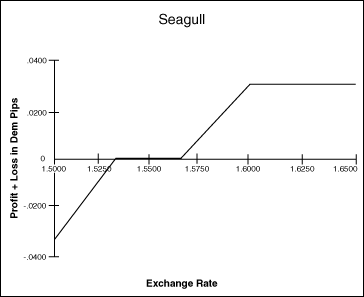
This strategy provides one with the right to buy USD at 1.5700, if spot is trading above 1.5700 at expiry, and with the obligation to sell USD at 1.6025, if spot is trading above 1.6025. One also has an obligation to buy USD at 1.5325 if spot is trading below this level at expiry, due to the short US$ Put option. The strategy is mainly used for trading purposes, but can also be used by a hedger with the conviction that the upmove will be limited. As the strategy is net zero cost, the strikes act as break-even rates, with the maximum profit for the option strategy limited to 325 DEM pips above 1.6025 DEM/USD, and potentially unlimited loss below 1.5325 DEM/USD.
Buy USD Call/DEM Put Strike 1.5700
with Knock-Outs at 1.5400 and 1.6400
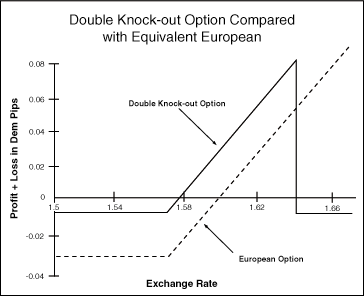
Net Premium Cost = 0.21% USD or 33 DEM pips
(vs. comparable European option cost of 1.83% USD or 293 DEM pips).
| Scenarios at Expiry | ||||
| Spot above 1.5700 | 1.5400 or 1.6400 not traded | Maximum profit 666 DEM pips | ||
| Spot below 1.5700 | 1.5400 not traded | Option lapses and premium forfeited. Maximum loss 33 DEM pips | ||
| Any Closing spot | 1.5400 or 1.6400 not traded | Option terminated and premium forfeited. Maximum loss 33 DEM pips. | ||
With this strategy, the purchased option becomes unexerciseable if spot trades at either knock-out level of 1.5400 or 1.6400 at any time before expiry. However, the premium cost of the option is significantly reduced compared with the European option due to the double knock-out feature. The break-even rate for the option is 1.5733 as opposed to a break-even rate of 1.5993 for the European option. The maximum profit for the option is 666 DEM pips, if neither knock-out level has traded, and the maximum loss is the premium, i.e. 33 DEM pips.
The following strategies show some examples of how options may be utilised by investors looking for potential yield enhancement structures.
| US Based Investor 3-month expiry | ||
| 3-month USD Deposit rate | 7.65% (Act/360) | |
| Purchased Option | USD Put DEM Call Strike 1.55 Expiry 3 months | |
| Option Premium | 1.40% of the US$ Amount | |
A portion of the interest that would be earned on the deposit is used to pay for the option purchase. Therefore, the principal amount deposited is not at risk.
| Minimum Return | 2.0% (Act/360) | |
| Maximum Return e.g. Return at 1.50 finishing spot |
2.0% plus FX gains below 1.55 15.18% US$ (Act/360) |
The return on the investment (quoted on an Act/360 basis) in this example will be defined by the following formula:
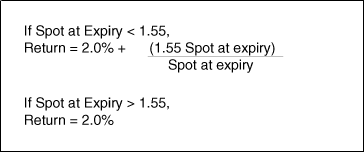
With this structure, the investor takes a view on the currency move. If the view is correct, the yield on the original deposit will be significantly enhanced; if the view is incorrect, the principal is preserved and a lower yield only is achieved.
Once again, a portion of the interest that would be earned on the deposit is used to pay for the option purchase. Therefore, the principal amount deposited is not at risk.
| US Based Investor 3-month expiry | ||
| 3-month USD Deposit rate | 7.65% (Act/360) | |
| Range Binary Limits | 1.52 and 1.62 | |
| Pay-out Ratio | 8.5:1 | |
| Premium Invested | 0.50% of the US$ Amount | |
| Minimum Return on Investment | 5.63% (Act/360) | |
| Maximum Return on Investment | 22.44% (Act/360) | |
| (provided that 1.42/1.62 range is not broken) | ||
In this case, premium is invested in a Range Binary with limits at 1.52 and 1.62. Provided that the spot FX rate stays within the prescribed range and does not trade at either of the range limits at any time (monitored on a 24-hour basis), a fixed multiple of the premium amount invested will be payable at maturity. If however, either of the limits trade at any time before the maturity date, the Range Binary will be terminated and the premium invested forfeited. The investor would then receive the full principal invested plus a deposit yield - this yield would be lower than the standard yield due to the deduction of the premium needed to finance the purchase of the Range Binary.
| US Based Investor 3-month expiry | ||
| 3-month USD Deposit rate | 7.65% (Act/360) | |
| Corridor Range | 1.52 and 1.62 | |
| Pay-out Ratio | 1.45:1 | |
| Premium Invested | 1.50% of the US$ Amount | |
Again, a portion of the interest that would be earned on the deposit is used to pay for the option purchase. Therefore,the principal amount deposited is not at risk.
| Minimum Return on Investment | 1.60% (Act/360) | |
| Maximum Return on Investment | 10.2% (Act/360) |
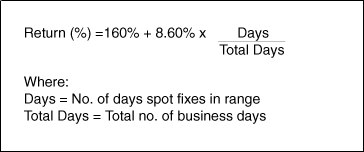
In this structure, premium is invested into a Corridor Option with limits set at 1.52 and 1.62. For each day that the spot stays within the prescribed range, a portion of the pay-out is locked-in; this pay-out is a multiple of the total premium invested. Therefore, if the spot stays within the range for every day of the period, the maximum pay-out will be due, but if the spot never fixes within the range, no pay-out will be due. The actual pay-out is calculated on a pro rata basis for the number of days that spot stays within the prescribed levels. The principal of the deposit is preserved with a minimum pay-out (in this case 1.60%) also assured. The return on investment is defined by the following formula:
Foreign Exchange Options are extremely flexible tools for the management of currency risk, and have proven to be valuable to corporate hedgers, investors, and traders alike.
Standard or vanilla options, and their more exotic relatives, enable risk managers to price and segment risk, assuming only as much risk as is acceptable and transferring the balance at a known cost.
This flexibility requires informed decision-making, and Genesis’s Foreign Exchange Options Group is dedicated to helping clients manage their risk with sophisticated tools and competitive pricing. Together with Genesis’s highly-trained worldwide FX Sales force, they offer tailored solutions to risk situations, innovative responses to market conditions, and assistance in managing existing trades. Genesis’s objective is simple: to be your number one risk management provider.

